Both the European Pharmacopeia and the United States Pharmacopeia (National Formulary) set the guidelines / public standards for substances. In the United States it is the FDA who enforces the laws for food and drug safety, and as the USP is a non-governmental, non-profit organization, the FDA also enforces compliance to the USP-NF guidelines.
Especially with all the new rules and regulations either implemented already or coming into force in due course, going from compendial based testing more towards risk based assessments and validations, now more than ever consistant quality is paramount in the pharma industry. This applies not least for consumables like our gaskets, screen and diaphragms to name a few.
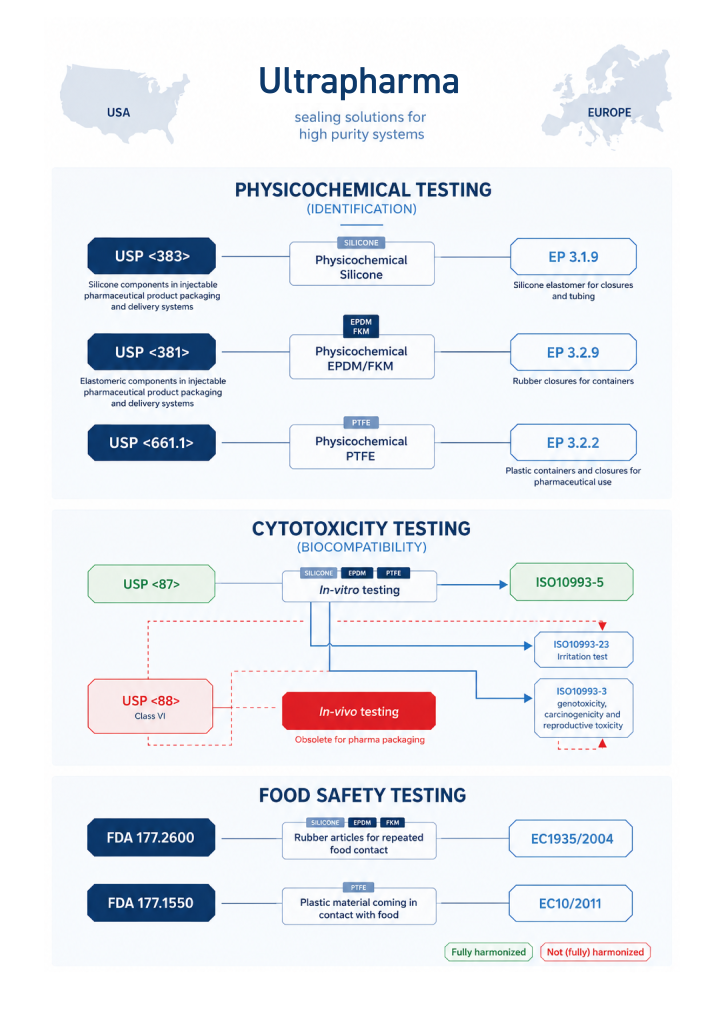
At Ultrapharma we understand this and not only do we have a solid grip on our supply chain, ensuring stable and uniform top quality our end-customers have enjoyed already for years and expect from us, we also substantiate our consistent quality, and not only in our QC where every batch of every product is tested. We (pro-)actively certify our compounds according to the latest monographs of the European, US and International pharmacopeia as well as Europe’s food contact regulations. In table above you’ll find the most common compendial tests listed.
USP <665> is a guideline for plastic components, and systems used to manufacture pharmaceutical drug products (DP) and biopharmaceutical drug substances (DS) and products. This goes both for single-use-systems (SUS) as well as multiple-use-systems (MUS). As stated in USP <665>, the testing of components is driven by the risk that the component could be unsuited for its intended use based on chemical or biological effects attributed to process equipment-related leachables (PERLs). As the risk that the component could be unsuited for use increases, the degree of required testing also increases. There are three risk levels (low, moderate, and high) and each of them corresponds to certain type of chemical tests based on the guidance of USP <665>.
This chapter is about plastics, and although elastomeric gaskets, diaphragms and O-Rings are out-of-scope, we are perfoming USP <665> tests on our most commonly used elastomeric compounds as well. This gives us and therewith our customers an advantage to ensuring the end-user can complete the full USP <665> assessment on time and in one go.